
Ten years ago, the average property investor in Pakistan had one default answer: buy a residential plot, wait, sell. The logic was simple, and the market rewarded it. Today, that thinking is showing its limits. Residential yields in most Lahore societies hover between 3% and 4% annually.
Good commercial property in the same city regularly returns double that, sometimes more. That gap is why commercial real estate has moved from a niche conversation to one of the most searched topics in Pakistan’s property market.
Still, commercial property is not a plug-and-play upgrade from residential investment. The due diligence is different. The risks are different. And the investors who have built real wealth here share one thing in common: they studied the asset before they bought it.
What Actually Falls Under Commercial Real Estate
At its core, commercial real estate is any property used for business purposes rather than housing. That definition covers an enormous range. A 2-marla shop on a society boulevard is for commercial use.
Investors buy commercial property for different reasons, and understanding your own motive matters before you start evaluating options:
- Earning rental income from business tenants on multi-year leases
- Holding land in a high-growth corridor and selling once values have risen
- Buying space to house your own business and stop paying rent to someone else
- Adding a different asset class to a portfolio that is currently all residential
- Building a long-term income asset that can eventually be passed on
The reason matters because it changes what you should buy. An investor chasing yield needs an occupied location with proven tenant demand. Someone buying for their own business has a completely different checklist.
The Main Types of Commercial Property in Pakistan
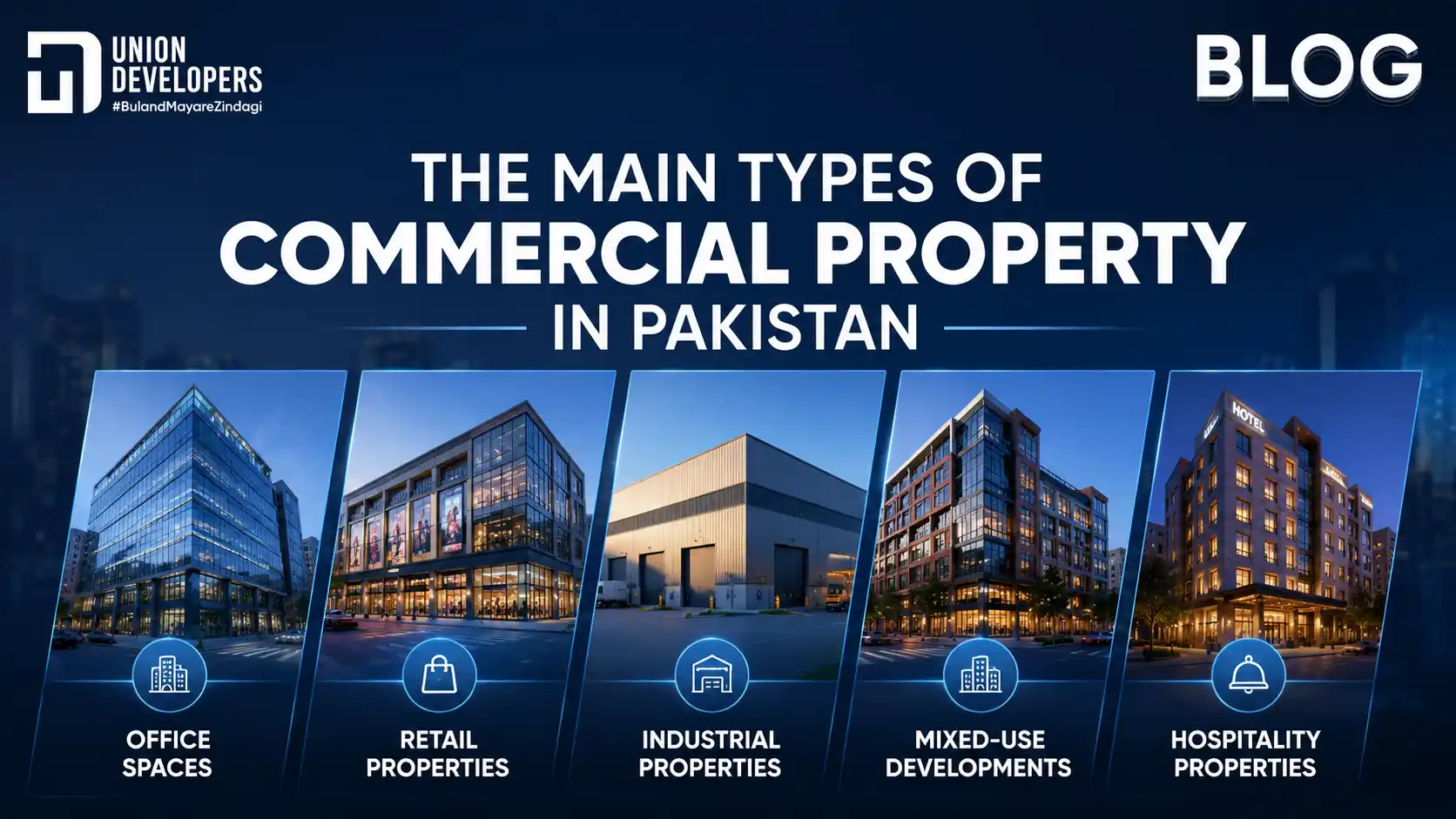
Pakistan’s commercial market covers more ground than most investors initially realise. Each property type attracts a different tenant profile and carries its own risk-return dynamic.
Commercial Plots remain the most straightforward entry point. Buy land with approved commercial use, then develop, lease out the rights or simply hold while the area matures. Boulevard-facing plots in societies like Union Town tend to move faster because buyers already trust the location fundamentals.
Retail Shops and Showrooms are where most rental income stories begin. Pharmacies, grocery outlets and food chains sign longer leases than most asset types and keep premises in decent shape because their business depends on it. The only real variable is foot traffic; get that right and the rest follows.
Office Space is more concentrated. Corporate tenant demand outside Lahore’s established districts is still thin, though technology firms and professional service providers are beginning to take up space in better-developed societies.
Mixed-Use Projects bundle retail, office and residential uses into one building. Done well, each component feeds the others. Done poorly, they sit half-occupied for years. Location and residential occupancy levels are the deciding factors.
How the Returns Actually Work
| Return Category | Metric | How It Works | Typical Pakistan Benchmark |
|---|---|---|---|
| Income Return | Gross Rental Yield | Annual rent ÷ purchase price × 100. For example, PKR 1.2 million annual rent on a PKR 15 million property produces an 8% gross yield. | Generally, 6%–10% in established commercial locations. |
| Income Return | Net Rental Yield | Gross rental income minus maintenance costs, taxes, management fees and other recurring expenses. | Usually around 1–1.5 percentage points lower than gross yield, often ranging between 6.5% and 7%. |
| Income Return | Vacancy Allowance | A realistic investment model should account for periods when the property may remain unoccupied. Ignoring vacancy can significantly overstate projected returns over time. | Investors commonly allow for 5%–8% vacancy in annual projections. |
| Capital Return | Capital Appreciation | Increase in property value over time. For example, a property purchased for PKR 15 million and later valued at PKR 18 million generates a PKR 3 million capital gain, excluding rental income. | Stronger in developing infrastructure corridors and high-growth locations; weaker in slow-moving markets. |
| Total Return | Net Total Return | Combined return from net rental income and capital appreciation after deducting acquisition costs, taxes, fees and selling expenses. | Should be calculated before purchase to assess the true investment potential. |
Commercial vs Residential Property: Key Differences
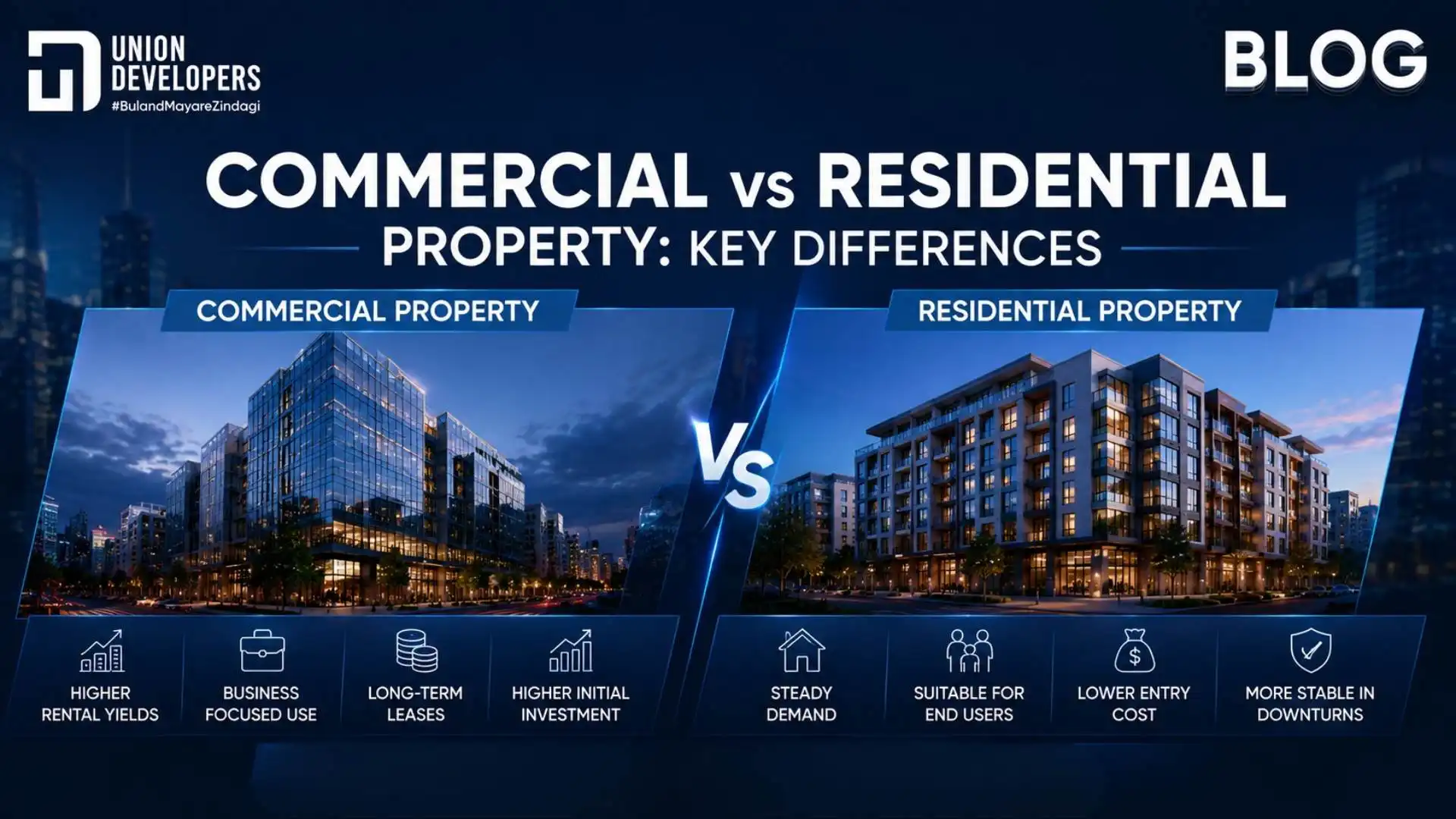
Most investors in Pakistan have experience with residential property and use it as their mental benchmark. The table below maps the real differences:
| Factor | What It Means in Practice |
|---|---|
| Upfront Capital | Commercial plots need substantially more capital than a comparable residential plot in the same society. |
| Rental Income | Gross yields of 6% to 10% are realistic in well-located commercial property; residential rarely crosses 4%. |
| Lease Terms | Business tenants typically sign leases of two to five years, giving owners more income predictability. |
| Vacancy Risk | Finding a replacement tenant after a vacancy takes longer for commercial than for residential property. |
| Ease of Resale | Residential plots have a broader buyer pool; commercial resale requires a more targeted buyer. |
| Who It Suits | Investors who prioritise income over simplicity and can absorb occasional vacancy. |
Evaluating a Commercial Property Before You Buy
Projected yields on paper mean very little if the property does not have the underlying conditions to support tenant demand. Before any purchase, the following factors deserve honest assessment:
- Road Access: Is the property reachable from at least one main road without difficult turns or congestion?
- Visibility: Can passing traffic see the property clearly, or is it obscured by other structures?
- Catchment Population: How many households are within a reasonable distance, and are they actually living there yet?
- Frontage: Wider street-facing frontage supports stronger rent. Narrow frontage limits tenant options.
- Parking: A retail tenant without accessible parking will lose customers and push back on rent.
- Utilities: Consistent electricity, water and internet are non-negotiable for business tenants.
- Land-use Approval: The authority must have designated the land as commercial. Assumed approval is not approval.
- Developer Credibility: Has this developer delivered other projects on time and as promised?
Remember:
“Real commercial demand starts when real people are living nearby and spending money nearby. This is why checking actual occupancy levels, not just sold units, matters significantly.”
The Due Diligence Side That Most Investors Skip

Pakistan’s property market has no shortage of cautionary stories. Title disputes, unapproved construction, undisclosed dues and forged documentation have caught buyers who moved too fast. The due diligence process is not particularly complicated, but it does require discipline.
Before any transfer should occur, the following needs to be confirmed and not just verbally assured:
- Ownership record verified through the relevant land authority, not just the seller’s paperwork.
- Approved land-use status confirming commercial activity is lawfully permitted on the plot.
- NOC status from the housing authority, development authority or relevant government body.
- Any outstanding dues to the society, utility providers or government.
- Confirmed transferability with no encumbrances, mortgages or court orders attached.
- Litigation check confirming no active legal disputes involving the property.
- Tax position, including applicable capital gains tax and property transfer charges.
Remember:
Hiring a property lawyer for this process costs a fraction of what a legal dispute costs later. The same is true for a tax advisor. Buyers who skip professional verification on the grounds of trust or urgency are the ones who end up in long, expensive disputes. Commercial real estate is not the place to economise on legal checks.
Choosing the Right Plot Size
Size selection is partly financial and partly strategic. The table below summarises how different sizes typically play out:
| Plot Size | Typical Use | Practical Consideration |
|---|---|---|
| 2 to 4 Marla | Single retail shops, pharmacy, small restaurant or service outlet. | Easiest entry point for first-time commercial buyers. |
| 6 Marla | Multi-floor commercial build with ground retail and upper offices. | Development flexibility improves noticeably at this size. |
| 8 Marla | Larger retail formats or compact mixed-use projects. | A practical midpoint that works well in community-facing locations. |
| 10 Marla & Above | Showrooms, corporate offices, purpose-built commercial buildings. | Wider tenant options, but require stronger capital and longer lease-up time. |
Lahore’s Commercial Market: Where the Real Activity Is
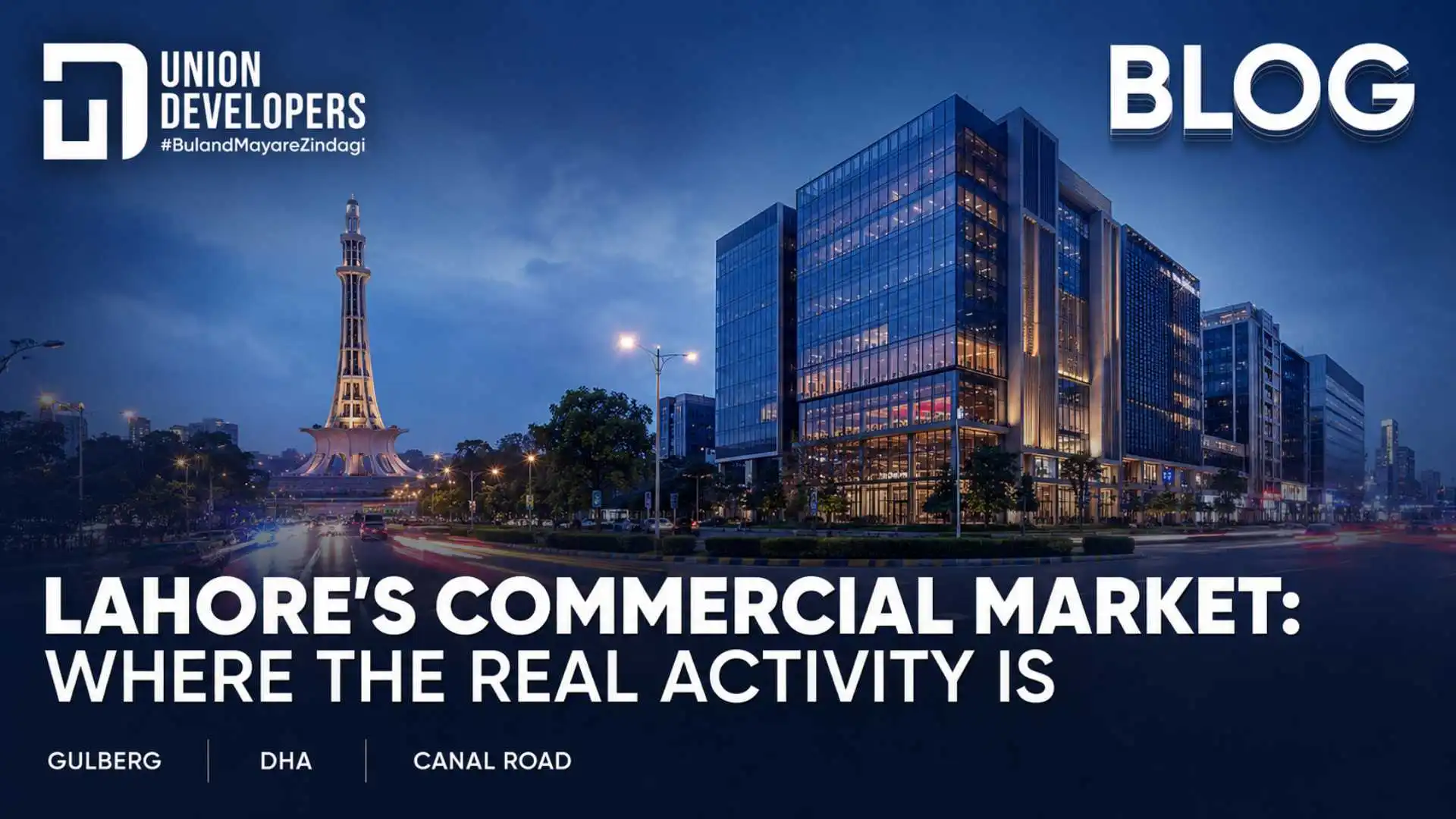
Lahore is the most active commercial property market in the country by transaction volume and investor attention. The city’s population has grown faster than its commercial supply in several key corridors, which means genuine unmet demand exists in the right locations.
Several dynamics are worth tracking:
- New road corridors connecting the Ring Road to developing societies are generating early-stage commercial interest.
- Master-planned communities with operational residential populations are seeing retail and service-sector vacancy rates fall.
- Boulevard-facing commercial plots in delivered communities are among the most sought-after formats right now.
The distinction between a society with sold plots and a society with occupied homes is critical to understanding commercial viability. Sold plots generate no commercial demand. Families living in those homes, shopping locally, sending children to nearby schools and using local services generate commercial demand.
Union Developers’ communities in Lahore, including Union Living and Union Greens Phase I, where residential occupation is already underway, represent the category where commercial investment is backed by an existing customer base rather than a future projection.
Risks Worth Knowing Before You Commit
Listing risks is not meant to discourage commercial investment. It is meant to ensure investors go in without surprises. The most common challenges in Pakistan’s commercial property market include:
- Vacancy that lasts longer than projected, particularly in areas where residential occupancy is still building.
- Overpaying because yield projections were based on optimistic rent assumptions rather than comparable market data.
- Title or legal complications that emerge after the transfer has already been completed.
- Developer delays that push back the timeline for a plot becoming developable or income-generating.
- Poor road access that limits the tenant types willing to occupy the property.
- Maintenance costs on developed property that were not fully accounted for in the initial return model.
Frequently Asked Questions
Q 1: Is commercial property genuinely a good investment in Pakistan?
For investors who research properly and buy in locations with real commercial demand, the income returns are considerably stronger than residential. The capital appreciation story depends heavily on location. Good locations have rewarded commercial investors well over the past decade. Poor locations have not moved much at all.
Q 2: What counts as a decent rental yield?
Most experienced investors in Pakistan work toward gross yields of 6% to 10%, with net yields settling one to two percentage points lower after costs. Anything below 5% net in commercial property usually reflects either an overpriced purchase or a location with weak tenant demand.
Q 3: What size should a first-time commercial buyer target?
Between 2 and 4 marla is the most practical starting range. Capital requirements are lower, the tenant pool for small retail is broader, and the learning curve is shorter. Starting smaller and buying again with better information is usually more profitable than starting large with incomplete knowledge.
Q 4: Can someone buy commercial property to run their own business?
Yes, and it is often a sensible decision for established business owners. Buying eliminates the uncertainty of lease renewals, removes the landlord from the equation and gives the owner an appreciating asset alongside their operating business. The key is buying in a location that works for the business, not just one that looks attractively priced.
Where to Go From Here
Commercial real estate in Pakistan is not a shortcut to returns. It is a more demanding asset class than residential property, and it rewards those who treat it that way. The fundamentals in Lahore remain among the most favourable in the country. For investors looking at commercial plot options in Lahore, Union Developers’ projects offer verified ownership, approved commercial land use and the advantage of communities where residential populations are already in place.