


Location, capital and relationships: Real estate has run on these three things for decades. None of them has gone away.
What has changed sits around them. A buyer scrolls a listing on a phone during a commute, books a virtual tour that evening, and gets a follow-up notification the next morning.
That shift now has a name: PropTech, short for Property Technology. What follows looks at what the term covers, how the industry got here, and where it seems to be heading.
What Is PropTech, Exactly?
PropTech is technology, data and digital tools applied to how property is developed, marketed, sold, managed and lived in. It is a far bigger idea than a website with listings on it.
Under this umbrella sit a few distinct categories:
- Search platforms and CRM systems, the kind buyers and sales teams use every day
- Artificial intelligence and machine learning
- Virtual reality and 3D visualisation
- GIS, used for mapping infrastructure and connectivity around a plot
- Digital twins and Building Information Modelling (BIM)
- Automated valuation models and analytics tools
In India, portals such as 99acres, MagicBricks and Housing.com show how far this has come. What began as basic listing sites now handle price trends, neighbourhood data and lead management within the same platform.
How PropTech Has Changed the Industry
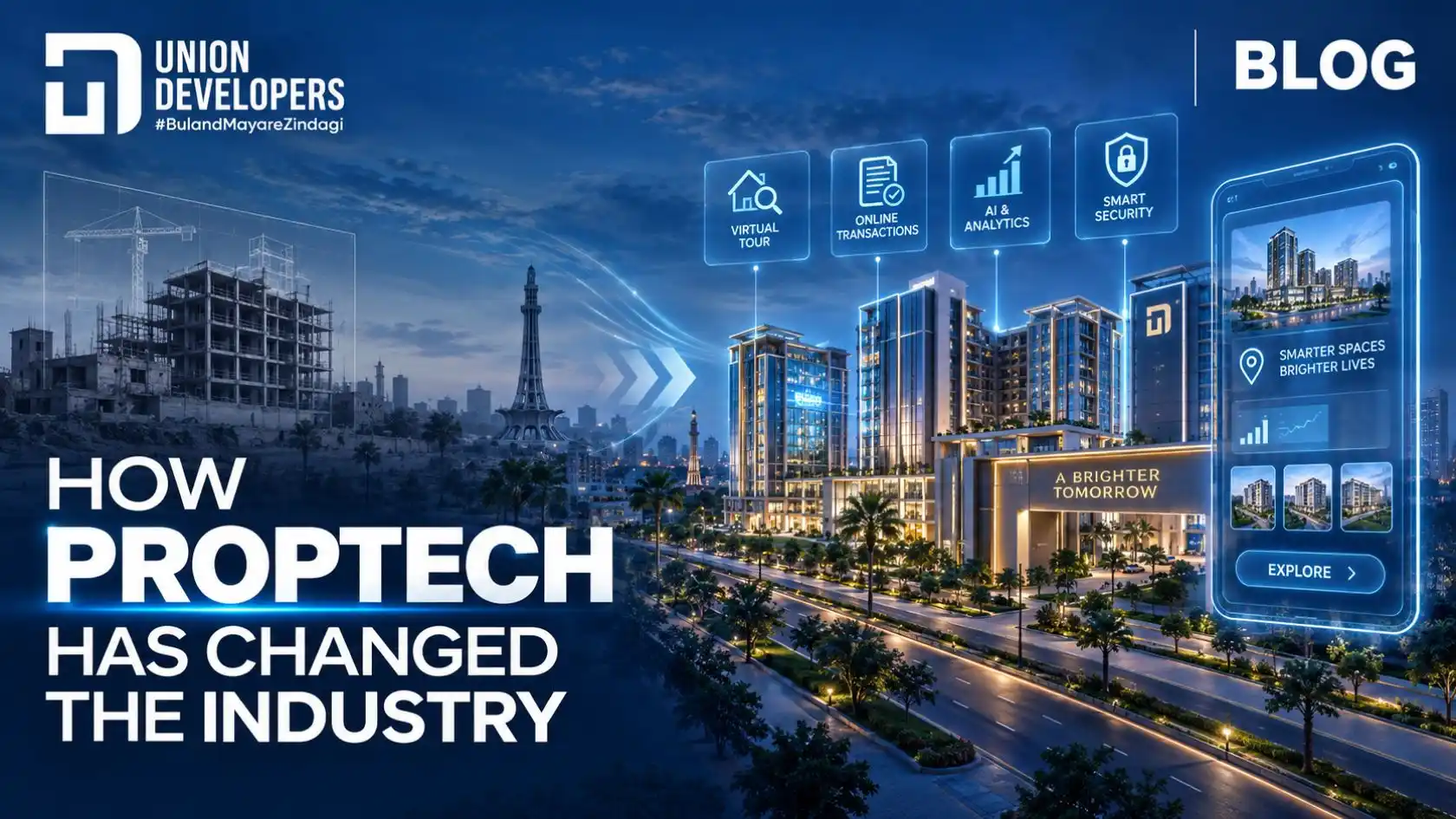
Twenty years ago, buying property meant agents, printed brochures, physical visits and word of mouth. Developers kept records across spreadsheets, inboxes and paper files that rarely spoke to each other.
However, much has changed. A buyer can research a project, compare it, take a virtual tour and review documentation before ever visiting the site.
Developers gain something more useful. Planning, construction, marketing, sales and after-sales service can now sit inside one connected system rather than five that do not talk to one another.
How Real Estate Technology Evolved
| Stage | What it involved |
| Traditional real estate | Physical visits, newspaper adverts, printed brochures, paper records |
| Digital discovery | Portals letting buyers browse listings from a single screen |
| Mobile real estate | Apps bringing alerts, enquiries and mortgage tools to a phone |
| Data-driven real estate | Analytics starting to guide pricing and demand decisions |
| AI-powered PropTech | AI spotting patterns and automating routine tasks |
Key PropTech Categories Worth Knowing
- Search and listing platforms reduce the time spent in property shortlisting through filters, comparisons and floor plans.
- AI and machine learning support valuation, lead scoring and personalised marketing, in the background.
- Virtual reality and 3D visualisation matter most for off-plan projects, or for buyers who live too far away to visit easily.
- GIS and location intelligence map out connectivity, land use and infrastructure around a site.
- BIM and digital twins create digital models of a building, sometimes linked to live data from the finished structure.
- Smart building systems put lighting, security, energy use and access control under remote management.
- Property management software brings maintenance, rent and tenant communication into one place instead of three.
PropTech and AI: What 2026 Actually Looks Like

AI dominates the conversation this year, but the interesting question is not whether developers use it. Valuation is one area. AI can weigh location, past sales and comparable properties, but this works best as an input to a valuer’s judgement rather than a replacement for it.
- Predictive analytics is another, looking at demand and buyer behaviour to suggest what might happen next.
- Customer service has probably seen the most visible change.
- Chatbots now field routine questions outside office hours, which matters given how many enquiries come in on evenings and weekends.
- On construction sites, drone footage and image analysis are catching delays and safety risks earlier than a manual walk-through typically would.
Commercial Real Estate Is Catching Up
Residential property gets most of the PropTech attention, but offices, retail units and warehouses are not far behind. Tenants can raise service requests, book shared spaces and access buildings through a single app.
Asset managers can watch occupancy, revenue and maintenance from one dashboard instead of stitching together several reports.
What PropTech Actually Delivers
| Benefit | Why it matters |
| Efficiency | Automation cuts down repetitive admin work |
| Better decisions | Data replaces a fair amount of guesswork |
| Customer experience | Buyers search and book without waiting on a call |
| Transparency | Digital records are easier to trace than paper ones |
| Speed | Lead management and paperwork move faster |
| Project oversight | Costs, schedules and risks are visible as they happen, not weeks later |
Features Worth Having in a Property App

Not every app needs every feature, but the useful ones tend to include:
- Location-based search with filters that actually narrow things down
- Virtual tours alongside genuinely good photography
- Mortgage or payment calculators
- Lead forms and appointment booking
- CRM integration and a chat function that works
- Analytics and AI recommendations running quietly behind the scenes
The apps worth building connect all of this to internal sales and service systems. One that sits disconnected from the rest of the business tends to underperform regardless of how it looks.
Common Challenges, and What Tends to Work
| Challenge | Practical response |
| High upfront cost | Solve one defined problem first, then expand |
| Data security | Build in encryption and access controls from day one |
| Legacy systems | Integrate in phases instead of ripping everything out |
| Staff resistance | Train people and show them what it fixes for them personally |
| Poor data quality | Sort out data governance before layering AI on top |
| Over-reliance on tech | Keep a person accountable for valuation and compliance calls |
What This Means for Homebuyers

Buyers can now research a project, its location, pricing and construction progress without depending entirely on a sales conversation. That is a genuine improvement. It does not remove the need for due diligence.
A well-made virtual tour or an AI-generated recommendation says nothing about a property’s legal or financial standing. Approvals, registration and contract terms still need checking through the proper official channels.
PropTech Is Opening Up New Careers
Property and technology skills are increasingly asked for together, which has created demand in areas such as:
- PropTech product management
- Real estate data analysis
- GIS and spatial analysis
- Smart building management
- Digital marketing for property
- Construction technology roles
None of this requires a software engineering background. A solid grasp of buyers, data and property processes is often enough to get started.
Is PropTech the Future of Real Estate?

Not exactly. PropTech will not replace real estate itself. Land, location, build quality and trust between buyer and developer still decide most outcomes.
What is changing is how well organisations use technology on top of those basics. The direction of travel points towards fewer standalone apps and more of one connected system running from land intelligence through to after-sales service.
The Road Ahead
AI, digital twins, GIS and smart buildings are moving from nice-to-have extras towards standard infrastructure. In India, technology increasingly sits underneath planning and transactions rather than functioning as an add-on marketing tool.
Developers who adjust early will likely find it easier to keep pace as buyer expectations keep shifting.
Frequently Asked Questions
Q1: What does PropTech mean in real estate?
It covers the technology and digital tools used across development, transactions, marketing, construction and property management.
Q2: What are examples of PropTech?
Property portals, AI valuation tools, virtual tours, smart buildings, GIS, BIM, digital twins and property management software.
Q3: How does AI help real estate?
It supports valuation, lead scoring, market analysis, predictive forecasting and customer service, usually alongside human judgement rather than instead of it.
Q4: Is PropTech only for large developers?
No. Smaller businesses use it too. The right tool depends on budget, scale and the specific problem at hand.
Q5: Does PropTech remove the need for due diligence?
No. Buyers should still verify documentation and approvals through official channels.
Q6: Is PropTech a viable career path?
Yes, particularly for people who combine property knowledge with data, marketing or technology skills.
Conclusion
PropTech has moved well past digital listings. It now shapes planning, construction, sales, property management and the careers available across the industry.
For developers, it means fewer manual gaps and better visibility into daily operations. Buyers, meanwhile, gain access to more information before a single site visit. In Punjab, the expanding digital land-record infrastructure is making technology increasingly relevant to property transactions and verification.
The organisations that succeed will not necessarily be the ones using the most technology. They will be the ones applying the right technology to the right problem, which is the actual point of PropTech.